What is Leadership Training really for?
From an HR perspective, Leadership Training can serve many different purposes.
To help newly promoted managers gain the knowledge and skills they need to perform their roles.
To assess participants and identify future executive talent.
To establish a common management approach across the organization.
To introduce new Best Practices that have not previously existed within the company.
Or to create opportunities for managers from different parts of the Organization to learn from one another.
Leadership Training can serve all of these purposes.
In many programs, participants first learn new concepts and approaches in the classroom.
They then use Case Studies and Discussion to compare those ideas with their own experience and translate them into their own words.
Finally, they may return to their own Organizations and consider how and when to put what they learned into practice.
Some companies also combine these programs with external Coaching or individual Training in areas such as Communication and Presentation.
Through this training, managers learn how to move their Organizations toward Business Goals and what it takes to do so.
There is real value in that.
But many participants discover something when they return to work.
They can’t always use what they learned immediately.
The same can be true in a sales organization, a manufacturing operation, or almost any other Function.
Why?
Many L&D professionals have probably experienced the Gap between positive post-training survey results and the Business Impact that becomes visible later.
The Training was useful.
New knowledge was acquired.
The concepts were understood.
And yet, back in the workplace, they are not always as usable as expected.
Sometimes, new knowledge even adds considerations that make people slower to act, not more effective.
Training can increase what managers know and what they are expected to consider.
But it does not always teach them how to use that knowledge in the reality of Management.
And this may be exactly what CEOs and other senior executives are concerned about.
The ability required to run a business.
The ability to grip an Organization and move it forward.
Could Leadership Training, intended to strengthen that ability, sometimes create additional friction and end up increasing the braking force instead?
Of course, this does not apply to every Leadership Training program.
But when significant time and money are invested without a clear connection to the final Business Result, executives may reasonably ask:
Is there a better way?
Should Organizations with different Business Goals and different organizational challenges really receive the same Leadership Training?
From HR’s perspective, Leadership Training isn’t necessarily meant to generate short-term Business Results.
It can also be a long-term investment in future Management Capability.
But does that explanation fully answer the question:
“How does this investment actually move the Business?”
There is a Business Goal.
There is an Organization.
There are Roles.
Accountability has been defined.
Yet relatively few situations let you apply a method learned from a textbook or a case to a real Organization and get the expected result.
Why?
Because every real Business operates within a Context that exists only for that Organization, that person, and that moment.
Leadership therefore requires more than simply applying what has been learned.
It requires understanding the Context, reconsidering the relationship among Business Goal, Accountability, Organization, and Role, and sometimes reconfiguring those relationships in order to produce an actual result.
We call this force that connects what exists to the result:
Leadership Utility.
We have one more question to explore.
Could Leadership Training be used not only to learn the right Behavior from pre-designed Cases, but also to help an organization discover the Leadership it will need next from its own real Business Context?
To explore this, let us return to Solveris Electronics, the fictional company familiar to readers of ERR& Insight.
The Solveris Case
Late afternoon, Liza Stone, Solveris Electronics’ HR Director, finally sat down for her usual late lunch.
That morning, her One-on-One with CEO John Smith had focused on Phase 2 of the PMI for the newly established TSMT.
Solveris Electronics, a precision equipment manufacturer with a seventy-year history, had long maintained stable performance.
Under CEO John Smith, the company expanded globally and moved parts of its manufacturing and development operations overseas to sustain growth.
In recent years, however, several issues had begun to emerge.
Turnover among middle managers was rising.
Development cycles were becoming longer.
Lead times had increased as production shifted overseas.
Against this backdrop, Solveris had launched a new medium-term business plan:
Vision X.
Vision X was more than another strategic plan.
It declared that Solveris intended to change its business structure.
One of its central initiatives was the acquisition of the emerging semiconductor company TWK and the establishment of a new company:
TWK–Solveris Micro Technologies, or TSMT.
By combining TWK’s power semiconductor technology and integrated system LSI capabilities with Solveris’ product-development expertise, the company intended to accelerate the development of inspection equipment for the aerospace industry.
At the same time, it hoped to build a clear product advantage over competitors.
TSMT was therefore one of the core Organizations supporting Vision X.
Build a new company.
Integrate it with the existing Solveris Organization.
Develop new products.
Bring them to market.
How quickly TSMT could achieve these goals became an immediate management priority.
John Smith had deliberately involved HR early in the PMI.
He expected HR not only to accelerate TSMT’s integration, but also to create new Synergy through people and Organization.
As Liza finished her hurried lunch and checked her emails over coffee, her phone rang.
It was Aki.
“Liza, sorry to call out of the blue. Do you have a few minutes?”
“I’m fine. I don’t have another Meeting until tonight.”
Liza glanced around the cafeteria.
“I’m still downstairs. Let me call you back when I get to the Office.”
She ended the call.
Aki—Akira Tanaka—had previously led Corporate Planning and was deeply involved in driving Vision X.
Six months earlier, at CEO John Smith’s request, she had been appointed Chief Engagement Officer, or CEnO, a newly created role intended to support the realization of Vision X from the perspective of people and Organization.
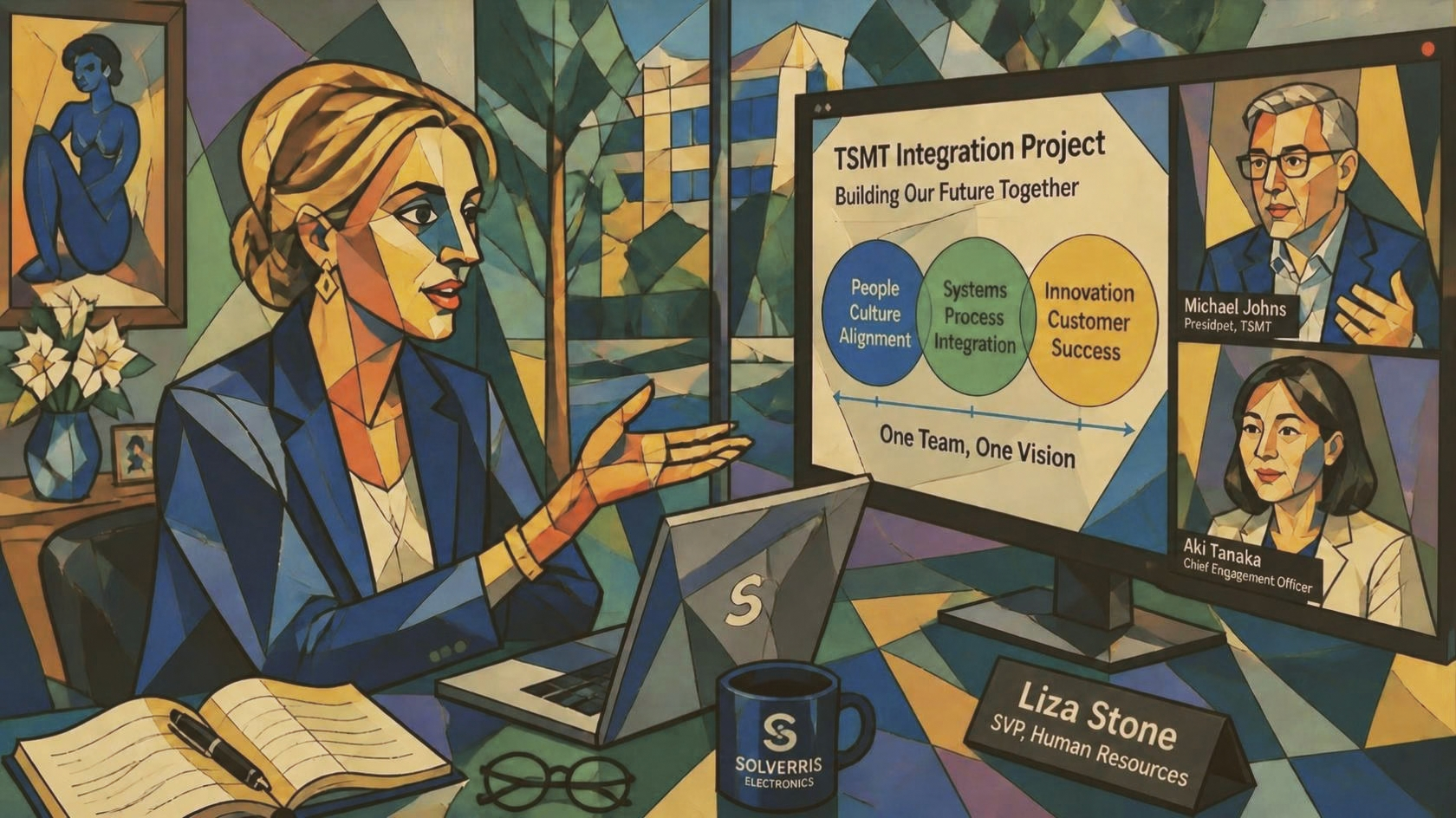
When Liza returned to her Office, a Video Call link from Aki was already waiting.
She clicked it.
A brand-new TSMT Meeting Room appeared on the screen.
Aki Tanaka was sitting there with TSMT President Michael Jones.
“Hi, what’s up, guys?”
Liza greeted them in her usual tone.
“Thank you for joining us, Liza.”
Michael spoke first.
Michael Jones held a PhD in mathematics and had previously led Solveris’ SCM function. John Smith had personally selected him to become President of the new company.
“As you probably heard, we have completed the integration phase through Day 100. This month we are moving into Phase 2, and we will begin the real integration with the existing Solveris Organization.”
Michael continued.
“First, take a look at this.”
The screen changed.
A detailed six-month Integration Plan appeared alongside a new TSMT Organization Chart.
Workstreams.
Milestones.
Owners.
Decision Points.
And weekly Action Plans.
Liza took one look at it and thought:
Very Michael.
“What I need from HR is the people required to make this Organization work and execute this Plan. I also need support for each BU Leader in managing their Organizations.”
Using a digital pen, Michael circled part of the Organization Chart.
“I want several experienced HRBPs assigned here.”
“John already mentioned that this morning.”
Liza answered as though she had expected the request.
“I’ll have Nicholas, our HRBP Head, send you a candidate list. I can’t promise the exact number yet, but I think probably two Full-time. The rest may need to be shared.”
Michael nodded.
“There’s one more thing.”
He paused.
“I’ve only been President for a few months, so perhaps this is presumptuous. But before the HRBPs arrive, I’d like you to see what this Organization actually looks like.”
Michael brought up another slide.
The title read:
Current Organization
Underneath was what looked like Michael’s handwritten working memo.
- President — Michael Jones / Solveris
- CFO — Michel Swinee / Solveris
- Technology Director — Owen Bloom / TWK
- Operations Director — Jack Lou / TWK
- Procurement Manager — Kathy Rose / TWK
- New Product Design Director — Lucas Blake / Solveris
Below the chart were several characteristics that an Organization Chart would never show.
Many of the Solveris Project Members were women.
Almost all of the TWK Project Members were men.
TWK operated largely from a Product-out mindset.
For them, the key question was how to apply new technology to a product.
Solveris, on the other hand, tended to regard Product Development itself as a form of Technology.
Its Engineers were more accustomed to building Engineering around Market and Customer Requirements.
At TWK, the strongest Engineer often became the center of a Team, regardless of age.
At the same time, university and laboratory networks were relatively influential.
Solveris was somewhat more affected by tenure and experience.
But academic networks played very little role.
At TWK, Kathy in Procurement was the only female Manager.
Liza studied the slide for a while.
“Hmm…”
She frowned slightly.
“Honestly, it doesn’t look like a particularly attractive Organization. But if TWK was a semiconductor development company, I’m not completely surprised.”
She looked at the slide again.
“But why are there so many women among the Solveris members in New Product Development?”
This time Aki paused before answering.
“The number of female Engineers from Solveris is partly the result of Michael’s decision.”
“Michael’s decision?”
“Academic networks.”
Aki said it with a slight sigh.
Liza logged into the HRIS and opened the TSMT New Product Development Organization Chart.
She checked the Solveris Engineer profiles one by one.
Relatively young.
Not particularly long-tenured.
And many held master’s degrees and came from laboratories at well-known universities.
“I see…”
Liza murmured.
“So gender itself isn’t the point. He wants a certain academic foundation and to make maximum use of existing professional networks in order to maintain productivity.”
Michael glanced at the time.
“Sorry, Aki. I’ll leave the rest to you.”
Then he turned to Liza.
“Liza, I have another Meeting. I’ll share both slides with you immediately.”
Michael stood up.
He’s got his hands full too, Liza thought, watching him leave through the screen.
The Meeting Room door closed.
Aki continued.
“So Diversity itself isn’t what Michael is worried about. In technology development, he cares more about whether the Engineers can communicate through a common professional language.”
She chose her words carefully.
“But manufacturing is different. We have two cultures—though perhaps ‘different operating principles’ is a better description. Their views on Product Development differ. The question is how to turn those two Organizations into one.”
“And whether they can actually produce results together.”
Liza said.
“Exactly.”
Aki nodded.
“You’ve read the DD Report. Before the acquisition, we concluded the cultures weren’t so different that integration would be impossible. I still think that conclusion was correct.”
She paused.
“But being able to work together and being able to produce results together are not the same thing.”
Liza listened quietly.
“TWK has its own Network in which people and organizations move around Technology. Solveris has another way of working — one that moves across Functions around Product Development.”
“And now we have relatively young Solveris Engineers entering the Organization, most of whom have almost no connection to TWK’s existing Networks.”
Aki looked directly at Liza through the screen.
“Gender makes some of those differences more visible. But I don’t think the real issue is men versus women.”
“The Professional Contexts are different?”
“Exactly. Michael’s real concern is whether management can combine the Organization Charts without fully understanding those differences and still expect the Synergy we promised.”
Liza thought for a moment.
“What do the Peakon results show?”
“Peakon?”
“The HRIS was already implemented on Day 1. We can use the Pulse Survey at TSMT, right?”
“We can.”
Aki answered.
“When Michael first spoke to me, I thought the same thing. We could use something like that to get an initial sense of where the issues were.”
She continued.
“A Pulse Survey can be a useful Tool for an Organization Head to understand Engagement and decide what actions to take. And an HRBP can help interpret the Data and support those actions.”
“Yes.”
“But we still don’t have an HRBP here.”
Aki continued.
“And more importantly, I don’t know whether it is right to measure two groups with different ways of working — and potentially different understandings of Engagement — using exactly the same scale.”
Pulse Surveys were certainly useful in understanding Engagement.
They could help identify what was reducing Engagement.
They could show which Organizations or populations were pulling down company-wide results.
That information could help Organization Heads decide what to do.
But TSMT wasn’t yet a complete Organization.
People with different operating principles were still trying to build one.
If they measured it using the same standards as an established Organization, what would the results really tell them?
Liza did not have a clear answer.
“You’re right… Peakon may be a little early.”
But she didn’t have an alternative either.
After a moment, Liza shifted the conversation.
“How is the Project itself going?”
“Neither particularly good nor particularly bad. At least for now.”
Aki answered.
“We’re still in the Design phase, so the TWK members are basically leading. But in about three months, we’ll gradually move into actual manufacturing.”
She paused.
“No one really knows what will happen then.”
“Manufacturing…”
Liza repeated the word.
“What is Lucas saying? How does he see it?”
Aki checked her Notebook.
“He’s extremely optimistic.”
“He says the Utilization of the Solveris members isn’t very high yet, but morale is still good. Once they move into manufacturing, he expects Utilization to rise naturally.”
Aki smiled.
“He also says working with the TWK people is fun.”
“Utilization…”
Liza repeated the word quietly.
For some reason, she remembered something John Smith had told her several months earlier.
— What I need is a methodology for maintaining high Organizational Engagement across the company, and a structure capable of making it happen.
That was what John had said.
Organizational Engagement.
Readiness.
Utilization.
The three words slowly connected in Liza’s mind.
“What is Lucas doing right now?”
“He’s working with the TWK people to build and deliver Knowledge Transfer Training for the new Solveris members.”
“On-site Training?”
Liza thought for a moment.
“How are the results? Do we have Test Scores?”
“Not bad. Engineers are usually highly motivated when they’re learning a new Technology.”
Then another conversation with John Smith came back to her.
This time, it had been about a new Leadership Training Program.
— If they understand what we teach them, their Test Scores will improve.
— If they practice what we teach them at work, some of the related Peakon Scores may improve too.
Then John paused.
— But that isn’t the Organizational Engagement I’m talking about. I’m looking for engagement that delivers business results.
Liza fell silent.
The Knowledge was being transferred.
The Test Scores were good.
Motivation was high.
And yet Lucas still said Solveris members’ utilization was low.
“Utilization…”
Liza repeated the word once more.
She returned to the HRIS and opened Lucas Blake’s profile, TSMT’s New Product Design Director.
Lucas had originally joined Solveris as a Quality Assurance Engineer.
He had studied Electrical Engineering and later completed graduate work in Statistical Methods related to Quality Management.
But his career at Solveris didn’t follow a straight line in that specialization.
Factory launch.
New product introduction.
Emerging-market entry.
SCM Projects.
His experience crossed Engineering, Operations, Product Development, and even Marketing-related Projects.
His Roles and Organizations had changed repeatedly.
Liza opened his Performance Review history.
The same kinds of comments kept appearing.
He brings energy to a project.
He gets people moving.
He finds a way to reach the goal.
Regardless of the domain, Lucas entered Projects, connected the people who were needed, and somehow brought them to the Goal.
Over time, Solveris had come to regard him as a kind of Project Specialist.
“You chose him, didn’t you?”
“Yes.”
Aki answered.
“I thought he would find a way to make this kind of assignment work. He’d worked on an SCM Project under Michael before. So I recommended him.”
Liza continued reading Lucas’ profile.
“What would you say his real strength is? In your own words.”
Aki thought for a moment.
“The ability to make things happen, maybe.”
Then she continued.
“He turns up everywhere. He takes action. And looking at the results, he rarely points in the wrong direction. He seems to have a very reliable compass.”
Aki smiled slightly.
“He’s the kind of Project Leader you need in the field. He’s worked on all kinds of Projects. And most importantly, he’s willing to get his own hands dirty.”
Liza looked at Lucas’ profile again.
Quality Assurance.
Factory Launch.
New Product Introduction.
Emerging Market.
SCM.
Viewed separately, it did not look like a particularly consistent Career.
But in every Project, Lucas had moved between people and Functions, connected what was needed, and eventually carried the Project to its Goal.
One word came to Liza’s mind.
Utility.
The ability to move things in the field.
There was Engagement.
There was Organizational Readiness.
There was Knowledge.
There were Skills.
But none of those alone produced results.
Read the Context.
Move the right people.
Cross Role boundaries when necessary.
Use Authority when appropriate.
Connect Functions.
And act personally to move the Business forward.
It was more than a Competency.
It was the ability to convert available Knowledge, Skills, Relationships, Roles, and Authority into an actual Business Result within a particular Context.
Leadership Utility.
Liza finally understood what she had been looking for.
And at the same time, John Smith’s idea of Organizational Engagement began to make more sense.
John was not simply looking for a high Engagement Score created by aggregating individual Survey responses.
People were connected to the Business.
They understood their Roles.
The Organization was ready to move.
But even that was not enough.
People had to use those connections.
When Context changed, they had to think.
They had to involve the right people and Functions.
Sometimes they had to move beyond the boundaries of their formal roles to push the Business forward.
Engagement had to appear inside the Organization as Utility that moved the Business.
Perhaps this was what John had meant by Organizational Engagement.
You couldn’t fully see it by simply adding up individual Survey Results.
And suddenly, Liza had a clearer idea of what she needed to do through the HRBPs at TSMT.
“The Utilization of the Solveris members is still low, right?”
She asked, almost to confirm her thinking.
“Yes. At least for now.”
Aki answered.
Liza thought for a moment.
“What if we tried a new Leadership Training program? Only at TSMT.”
“Leadership Training?”
“Yes. It would have to be improvised, so I don’t think we should try to make it elaborate.”
Liza looked at Lucas’ profile again.
“First, let’s ask Lucas to talk about some of the Projects he has worked on at Solveris. A Factory Launch. A New Product Introduction. Anything like that. What happened, where he got stuck, whom he involved, and how he eventually reached the Goal.”
“So we teach his success stories?”
Aki asked.
“Not exactly.”
Liza shook her head.
“I don’t want people to copy what he did. I want them to understand why he thought the way he did. What he noticed. How far he acted himself. What he chose to leave to someone else.”
“Then we use that as material for Discussion.”
Aki listened.
“And after that, we ask what all of this means in the Context of TSMT.”
Liza continued.
“If we can share those observations and turn them into a common language, perhaps the Norm this Organization needs will gradually become visible.”
Aki thought for a moment.
“What’s the theme?”
Liza answered without hesitation.
“Leadership Utility.”
Liza’s Training Experiment took place two weeks later.
It was not an elaborate Program.
Every member of the New Product Design Team participated.
Nicholas, Head of HRBP, facilitated the session.
Liza and TSMT President Michael joined as Observers.
Lucas began by discussing three Projects he had worked on at Solveris.
A Factory Launch.
A New Product Introduction.
And an Emerging-market Entry.
None of those projects began with a clear answer.
Things had not always gone according to plan.
Some problems had fallen outside his formal Role.
Some decisions should technically have belonged to other Functions.
Sometimes the people he needed were not there.
Lucas explained, one by one, what he had thought, whom he had approached, and what he had chosen to take on himself.
The participants then divided into smaller Groups.
What would we do if the same Situation happened at TSMT?
Where does my Role end?
When should something be escalated?
Is it acceptable to cross a Role boundary if that is what it takes to achieve the Goal?
If I do not have Authority, does that mean I can do nothing?
The Discussion continued well beyond the scheduled time.
It was probably the first time that TWK and Solveris members had sat at the same Table and spoken this openly about how they actually worked.
After the Training ended and everyone else had left, Liza and Michael remained in the Meeting Room.
As Liza packed up her laptop, Michael spoke.
“Liza.”
“How was it?”
Michael thought for a moment before answering.
“Honestly, I wasn’t expecting very much at first.”
Liza turned around and smiled.
“I thought so.”
“I’ve always thought that Leadership Training should first define the Behavior we expect and make sure everyone understands it.”
Michael continued.
“Then you teach people what they need to do to develop that Behavior. Next comes Practice. And finally, Feedback.”
Liza nodded silently.
Michael looked down at the Discussion Notes left on the Table.
“But most of what they talked about today wasn’t in my Day 1 Presentation. And it isn’t clearly written in their JDs either.”
He paused.
“I’m not saying I underestimated those things. Not at all.”
Michael thought for a moment.
“Maybe I simply assumed that these were things we didn’t need to put into words at Solveris.”
Liza said nothing.
“Everyone doing the obvious things properly. I thought that was what it meant to manage an Organization.”
Michael continued.
“But perhaps it’s too early to expect the ‘obvious’ in an Organization that hasn’t really finished becoming an Organization yet.”
“Do you want to control everything yourself? Build a Program for all of it?”
Liza asked.
Michael shook his head.
“No. That’s not what I mean.”
Then he smiled.
“I don’t want to manage everything myself.”
Liza laughed.
“Aki said the same thing.”
Michael looked at the Discussion Notes once more.
“I suppose managing something and deciding everything in advance are not the same thing.”
The two left the Meeting Room and walked side by side down the corridor.
Michael spoke again.
“Leadership Utility…”
He thought for a moment.
“It’s not just Lucas. Things that happened every day at Solveris, almost without anyone noticing, aren’t automatic here. I understood that today.”
Then he added:
“This may be worth pursuing.”
Liza nodded.
No one yet knew what results this small Experiment at TSMT would eventually produce.
But Liza understood one thing.
Leadership Training should develop more than expected Behavior.
It should develop the ability to move the Business in a Context where no answer is predetermined.
Leadership Utility.
And the objective of this Training was not to reproduce Lucas’ success formula.
We wanted to understand, within TSMT’s actual Business Context, what moved the Organization—and what held it back.
And to continue accumulating that Learning.
Liza’s Experiment had only just begun.
What Is Leadership Utility?
In the Solveris case, we described how people read uncertain situations and move an Organization in the right direction.
They understand their own positions.
But when necessary, they move beyond those boundaries.
They take the right action at the right time.
People sometimes interpret these behaviors as characteristics of well-trained, highly motivated individuals.
They may also be regarded as behavioral Norms that naturally emerge in Organizations with high Engagement.
But we believe another element is involved.
We call it Leadership Utility.
Leadership Utility is not simply another Leadership Competency.
Nor is it a Keyword for increasing Engagement.
It is the ability to understand the Context in which a Business Goal must be achieved, reconsider the relationships among Accountability, Organization, and Role, and convert available Knowledge, Skills, Relationships, Authority, and Functions into actual action.
As a result, the actions required from the same person may change when the Context changes.
In one Situation, the person may need to step forward personally.
In another, they may need to delegate.
Sometimes they may need to cross Role boundaries.
At other times, protecting those boundaries may be the right answer.
Sometimes Escalation is necessary.
Sometimes the individual must decide.
The point is not to reproduce one particular Behavior.
The point is to determine what to use in that Context to move the Business forward, then act.
If Competency asks:
What can this person do?
Leadership Utility asks:
How effectively can this person use what they have to produce a Business Result in this Context?
Seen this way, Leadership Utility differs somewhat from conventional static Competency models.
Utility is also not limited to the individual.
When people verbalize, share, and eventually expect the patterns through which someone like Lucas repeatedly demonstrates Utility across different Contexts, those patterns can gradually become part of an Organization’s own Norms.
But those Norms are not necessarily universal either.
When Context changes, the Utility required may also change.
That is why, when considering Leadership Utility, we believe four elements must always be considered together:
Accountability
Business Goal
Organization / Roles
Context
The form of Utility required depends on the combination of these four elements.
And when necessary, leaders use:
Management
Authority
Function
Execution
as levers that translate those relationships into real action and move the business forward.
That is Leadership Utility.
Leadership Utility is not simply seeing the big picture.
It is the ability to use that broader perspective to reconfigure these elements — including Context — and drive the Business.
Bringing Training Back to the Business Context
In the TSMT case, Training also functions as a Change Management intervention within PMI.
People from TWK and Solveris begin to put their ways of working into words.
They begin to understand each other’s Contexts.
And they begin to create new Norms.
In that sense, Training can certainly be viewed as a change management tool.
But we are not proposing that Leadership Training should become a Change Management Tool.
Instead, we suggest expanding Training’s role.
A conventional Leadership Training flow often looks something like this:
Case → Discussion → Learning → Workplace
Participants study a Case, discuss it, generate Learning, and then take that Learning back to work.
What Liza did at TSMT was almost the reverse:
Workplace → Experience → Dialogue → Learning → Workplace
Start with what is actually happening in the Business.
Reflect on what people did.
Put into words why they acted the way they did.
Share those observations with others.
Consider what that Organization’s specific Context requires.
Then go back into the Business and try again.
Here, Training is no longer simply a place for Knowledge Transfer.
It serves at least three functions.
The first is Development.
Learning, through real experience, how Utility actually moves the Business.
The second is Discovery.
Identifying what kind of Leadership Utility that particular Organizational Context requires.
The third is Change Intervention.
Sharing those Learnings and using them to help a new Organization form its own Norms.
At TSMT, this third function is directly connected to PMI.
But PMI is only one possible Context.
Leadership Utility can be developed and observed in many other settings.
New businesses.
Turnarounds.
International expansion.
Large-scale Projects.
Organizational transformation.
Or simply a Business that has reached the point where its established way of working no longer produces the answer.
When Context changes and existing Roles and processes no longer move the Business, Leadership Utility becomes particularly visible.
In that sense, the people we often call Change Leaders may need Leadership Utility most.
A Change Leader does more than operate an established System correctly.
They should move forward while the context changes, continually reassessing the relationship among Business Goal, Accountability, Organization, and Role.
However:
Leadership Utility ≠ Change Leadership
We see Change Leadership as one of the contexts where Leadership Utility is most visible.
Scale the Learning, Not the Solution
Even if the Training at TSMT is successful, it doesn’t mean the same Program should roll out across Solveris.
TSMT has its own Context.
The broader Solveris Organization has another.
The important thing is not to scale the Solution created at TSMT.
It is to Scale the Learning.
In what context did Utility become necessary?
When the Business stopped moving, where did role and authority boundaries become barriers?
Who crossed those boundaries?
Which decisions actually produced results?
What had to be verbalized before Organizational behavior began to change?
Those are the Learnings that should be brought back to Solveris and reconsidered within a different Context.
Scale the Learning, Not the Solution.
Perhaps Leadership Development can be viewed this way.
Our message through the TSMT case is not that we should reject conventional Leadership Training.
Nor are we suggesting that Training should only be used for Change Management.
Rather, the questions are broader.
What should Leadership Development teach?
But also:
What should we learn from the Business itself?
And:
How do we discover, articulate, and develop the Leadership that actually moves the Business?
And further:
How should we identify the people to whom we should entrust those responsibilities?
Leadership Training can move from a place where predetermined answers are taught to a place where:
The Organization learns from its own Business Context what kind of Leadership it will need next.
The small Experiment that began at TSMT is one attempt to:
Bring Leadership Development back into the Business itself.
(Originally posted on LinkedIn on 2026-10-02)
About Errand Consulting
Errand Consulting explores organizational transformation
through the ERR& Philosophy.
Learn more → www.hrfd3.com
ERR& Insight
Leadership Trainingは、Businessを本当に動かしているのか?
Leadership Trainingとは何でしょうか。
人事部門にとって、Leadership Trainingが持つ意味は一つではありません。
新しく昇格したManagerに、その役割を遂行するために必要な知識・スキルを身につけてもらうこと。
Trainingを通じて参加者を評価し、将来の幹部候補を見つけ出すこと。
企業として共通のManagementの考え方や方法を共有すること。
これまで社内になかった新しいBest Practiceを導入すること。
あるいは、普段は異なるOrganizationで働くManager同士の人材交流を促すこと。
Leadership Trainingには、さまざまな目的があります。
多くのトレーニングでは、まず座学を通じて新しい知識や考え方を学びます。
そしてCase StudyやDiscussionを通じて、それを自分自身の経験と照らし合わせながら、自分の言葉で理解していきます。
最後には、それぞれが自分のOrganizationへ持ち帰り、どのように実践するのか、その方法やScheduleを考えることもあります。
さらに、外部の専門家によるCoachingやCommunication、Presentationなどの個別Trainingを組み合わせる企業もあります。
こうしたTrainingを通じて、ManagerたちはBusiness Goalを達成するために、Organizationをどのように動かしていくべきか、そしてそのために何が必要なのかを学んでいきます。
それ自体には大きな意味があります。
しかし、多くのLeadership Trainingの参加者が、Trainingを終えて自分の職場に戻ったとき、あることに気づきます。
習ったことを、そのまますぐに使えるわけではない。
典型的な営業組織であっても、製造部門であっても同じです。
それはなぜなのでしょうか。
多くのL&D部門の企画担当者は、Leadership Training直後のアンケート結果と、その後に確認されるBusiness Impactとの間にあるGapを経験しているのではないでしょうか。
Trainingそのものは役に立った。
新しい知識も得た。
考え方も理解した。
しかし、実際に現場へ戻ってみると、思ったほど使えなかった。
場合によっては、新たに得た知識によって考慮すべきことが増え、以前より動きづらくなることさえあります。
Trainingによって知識や注意すべき事項は増える。
しかし、それを現実のManagementの中でどう使うのかまでは、必ずしも教えてくれません。
そしてCEOをはじめとする経営幹部が気にしているのは、まさにこの点ではないでしょうか。
経営に必要な力。
Organizationをグリップし、前に進める力。
その力を高めるために行っているはずのLeadership Trainingが、新たな摩擦を生み、結果として制動力だけを高めてしまってはいないか。
もちろん、すべてのLeadership Trainingにこのようなことが当てはまるわけではありません。
しかし、多大な時間と費用を投じているにもかかわらず、それが最終的なBusiness Resultに必ずしも結びついていないのではないか。
もっと良い方法はないのか。
そもそも、異なるBusiness Goalや組織課題を持つすべてのOrganizationに、同じLeadership Trainingを提供してもよいのか。
そのような疑問が経営側から出てくることは、不思議ではありません。
人事部門から見れば、Leadership Trainingは必ずしも短期的なBusiness Resultだけを目的とするものではありません。
将来のManagement Capabilityを高めるための中長期的な投資でもあります。
しかし、その説明だけで、
「では、その投資は実際にBusinessをどう動かしているのか」
という問いへの回答になるでしょうか。
Business Goalがある。
Organizationがある。
Roleがある。
Accountabilityも定められている。
それでも、教科書やCaseで学んだ方法を、そのまま現実のOrganizationに当てはめて成果を出せる場面は、それほど多くありません。
なぜでしょうか。
現実のBusinessには、そのOrganization、その人、その時点にしか存在しない Context があるからです。
そしてLeadershipに必要なのは、学んだ知識を単純に適用することではありません。
そのContextを理解しながら、Business Goal、Accountability、Organization、Roleの関係を読み直し、ときにはそれらを組み替えながら、実際の結果につなげていくことです。
私たちは、この「結果につなげるために働く力」を、Leadership Utility と呼んでいます。
そして今回、もう一つ考えてみたいのは、Leadership Trainingそのものの使い方です。
Trainingを、あらかじめ用意されたCaseから正しいBehaviorを学ぶ場としてだけではなく、
実際のBusiness Contextから、これから必要になるLeadershipをOrganization自身が発見する場にすることはできないか。
では次に、ERR& Insightではおなじみの架空の企業、Solveris Electronicsを使って考えてみましょう。
The Solveris Case
その日の午後、Solveris ElectronicsのHR Director、Liza Stoneは、いつものように遅い昼食をとっていた。
午前中に行われたCEO John SmithとのOne-on-Oneのテーマは、新会社TSMTのPMI、その第二フェーズについてだった。
創業70年を迎える精密機器メーカーSolveris Electronicsは、長年にわたり安定した業績を維持してきた。
CEOのJohn Smithは、事業のグローバル化と製造・開発機能の海外展開を進めながら、企業の成長力を維持しようとしてきた。
しかし近年、中間層の離職率の上昇、開発サイクルの遅延、海外生産へのシフトに伴うリードタイムの増大など、いくつかの課題が顕在化していた。
そのような中で策定された新中期経営計画「 Vision X」 は、単なる中期計画ではなかった。
それは、Solverisが自らの事業構造を変えるという宣言でもあった。
その象徴の一つが、新興半導体メーカーTWKの買収と、新会社 TWK–Solveris Micro Technologies(TSMT) の立ち上げである。
TWKが保有するパワー半導体技術と統合型システムLSIを活用し、Solverisがこれまで十分に参入できていなかった航空宇宙産業向け検査装置の開発を加速する。
同時に、競合他社に対して商品力で明確な優位性を築く。
TSMTは、Vision Xが掲げる新規事業戦略の中核組織だった。
新会社を立ち上げる。
Solverisの既存のOrganizationと融合させる。
そして、新製品を開発し、市場へ投入する。
それをどれだけ速く実現できるかが、目下の経営課題だった。
John Smithは、HRをPMIの早い段階から巻き込むこでて、TSMTの立ち上がりを加速させると同時に、新たなSynergyを人とOrganizationの側から生み出すことを期待していた。
Lizaが慌ただしい昼食を終え、コーヒーを飲みながらスマートフォンでメールを確認していると、突然着信が入った。
Akiからだった。
「Liza、突然ごめんなさい。今、少し話せる?」
「大丈夫よ。次は夜までMeetingはないわ」
Lizaはそう答えて周囲を見回した。
「今カフェテリアなの。Officeに戻ったらCall backするわ」
彼女はそう言って電話を切った。
AkiことAkira Tanakaは元経営企画部長で、Vision Xを推進するため、CEO John Smithの要望によって新たに設置されたChief Engagement Officer(CEnO)に半年前に就任したばかりだった。
Officeに戻ると、すでにAkiからVideo Callのリンクが届いていた。
Lizaがリンクをクリックすると、画面には真新しいTSMTのMeeting Roomが映った。
そこにはAki Tanakaと、TSMT PresidentのMichael Jonesが座っていた。
「Hi, what’s up, guys?」
Lizaはいつもの調子で画面の向こうの二人に声をかけた。
「Thank you for joining us, Liza.」
最初に口を開いたのはMichaelだった。
Michael Jonesは数学の博士号を持つ元SCM部門の責任者で、John Smithの指名によって新会社のPresidentに就任した人物だった。
「君も聞いていると思うが、TSMTはDay 100までの統合フェーズを完了した。今月からPhase 2に入り、いよいよSolverisの既存Organizationとの本格的な融合を進めることになる」
Michaelは続けた。
「まず、このSlideを見てほしい」
画面が切り替わり、MichaelのPCから一枚のSlideが共有された。
そこには、今後6か月の詳細なIntegration PlanとTSMTの新しいOrganization Chartが描かれていた。
各Workstream。
Milestone。
Owner。
Decision Point。
そして週単位に細分化されたAction Plan。
Lizaは一目見て、いかにもMichaelらしいプレゼンだと思った。
「HRにお願いしたいのは、このOrganizationを実際に動かし、このPlanをExecutionするために必要な人員を確保すること。それから、各BU LeaderのOrganization Managementを支援することだ」
Michaelはタッチペンで画面上のOrganization Chartを丸で囲った。
「経験のあるHRBPを何人か、こちらに入れてほしい」
「その話は今朝Johnからも聞いているわ」
Lizaは予想していたと言わんばかりに答えた。
「HRBP HeadのNicholasから候補者リストを送らせる。何人出せるかはまだ分からないけれど、今の体制ならFull-timeで2名。あとは兼務になると思うわ」
Michaelは小さくうなずいた。
「それから――」
少し間を置いて続けた。
「まだPresidentになって数か月の私が、君にこんなことを言うのは僭越かもしれない。でも、HRBPを入れる前に、今このOrganizationがどういう状態にあるのかを、君自身にも見てほしい」
Michaelはもう一枚のSlideを表示した。
タイトルには、
Current Organization
と書かれていた。
その下には、Michael自身が備忘録として書いたような手書きのメモが並んでいた。
- President — Michael Jones / Solveris
- CFO — Michel Swinee / Solveris
- Technology Director — Owen Bloom / TWK
- Operations Director — Jack Lou / TWK
- Procurement Manager — Kathy Rose / TWK
- New Product Design Director — Lucas Blake / Solveris
さらにその下には、Organization Chartには現れない特徴が箇条書きで書かれていた。
Solverisかに加しているProject Memberには女性が多い。
TWK側のProject Memberは、ほぼ全員が男性。
TWKは、Product-out型のものづくりを重視する。彼らにとって、新しいテクノロジーをどう製品に応用するかが重要である。一方で、Solveris Product DevelopmentそのものをTechnologyとして捉える傾向が強く、MarketやCustomer RequirementからEngineeringを組み立てる。
TWKでは、優秀なEngineerがTeamの中心となり、年齢はあまり重視されない。
一方で、出身大学や研究室などの人的Nネットワーク比較的強い。
Solverisは、どちらかといえば社歴や経験年数が影響する。
ただし、学閥的なつながりはほとんどない。
TWKで女性ManagerはProcurementのKathyだけだった。
LizaはしばらくSlideを眺めた。
「Hmm……」
少し眉をひそめる。
「正直に言えば、あまり魅力的なOrganizationには見えないわね。でも、TWKが半導体のDevelopment Companyなら、それほど驚きもしないわ」
そして、もう一度スライドを見た。
「でも、Solverisから来ているNew Product DevelopmentのMemberに女性が多いのはなぜ?」
今度はAkiが少し間を置いてから答えた。
「Solverisから女性Engineerが多く入っているのは、Michaelの意向もあって、こうなったの」
「Michaelの意向?」
「学閥よ」
Akiはため息交じりに、少し押し殺したような声で言った。
Lizaは自分のPCからHRISにアクセスするとしMTのNew Product Development ProjectのOrganization Chartを開いた。
Solverisから参加しているEngineerのProfileを一人ずつ確認する。
比較的若い。
社歴もそれほど長くない。
そして、その多くが修士号を持ち、有名大学の研究室出身だった。
「なるほど……そういうことね」
Lizaは画面を見ながらつぶやいた。
「性別そのものがポイントではない。一定の学術的なバックグラウンドを確保し、既存のNetworkを最大限活用することで生産性を維持したいということね」
Michaelは時計に目を落とした。
「Sorry, Aki。あとは頼む」
そしてLizaに向かって言った。
「Liza、私は次のMeetingに行かなければならない。今見せた二枚のSlideは、すぐ二人にShareしておく」
Michaelはそう言って席を立った。
彼も大変ね。
Michaelの後ろ姿を画面越しに見ながら、Lizaはそう思った。
画面の向こうでMeeting Roomのドアが閉まった。
Akiが続けた。
「だから、Michaelが気にしているのは、いわゆるDiversityそのものではないの。技術開発においてはDiversityそのものより、Engineerとしての共通言語が通じるかどうか。そこを重視した結果なの」
Akiは言葉を選びながら続けた。
「でも、ものづくりは別。二つの文化……文化というより、仕事に対する行動原理と言った方がいいかもしれない。特にProduct Developmentに対する考え方が違う二つのOrganizationを、どう一つにしていくか」
「そして、それで本当に成果を出せるのか」
Lizaが言った。
「そう」
Akiはうなずいた。
「DD Reportを読めば分かると思うけれど、私たちは買収前から、この二つの会社の文化は統合できないほど違っているわけではないと考えていた。実際、それは今でも間違っていないと思う」
Akiは一度言葉を切った。
「でも、“一緒に働ける”ことと、“一緒に成果を出せる”ことは同じではないのよね」
Lizaは黙って聞いていた。
「TWKには、Technologyを中心に人とOrganizationが動く独特のNetworkがある。Solverisには、Product Developmentを中心にFunctionを横断して動く、また別のやり方がある」
「そこに今回、Solverisから比較的若く、既存のTWKのNetworkとはほとんど接点を持たないEngineerが多く入ってきた」
Akiは画面越しにLizaを見た。
「Genderもその違いをより目立たせる一つの要素になっている。でも問題は男性か女性かということではないと思う」
「二つのProfessional Contextが違うということ?」
「そう。それを経営が十分に理解しないままOrganization Chartだけ一つにして、本当に期待しているSynergyが出るのか。そこが今、Michaelが一番不安に思っていることだと思う」
Lizaはしばらく考えた。
「Peakonの結果はどうなのかしら」
「Peakon?」
「HRISの導入はDay 1で終わっているはずでしょう。TSMTでもPulse Surveyは使えるわよね」
「使えるわ」
Akiは答えた。
「Michaelから相談を受けた時に、私も最初はそう思った。そういったもので、まず当たりをつけていくしかないかなって」
そして静かに続けた。
「Pulse Surveyは、Organization HeadがMemberのEngagementの状況を把握して、必要な手を打つためには有効なToolだと思う。そしてHRBPが、そのDataの見方や打ち手についてOrganization HeadをSupportするのよね」
「そうね」
「でも今回は、まだHRBPはいない」
Akiは続けた。
「そして何より、Engagementに対する認識が同じとは限らない、異なる行動様式を持つ二つの集団を、一つの基準で測ることが本当に正解なのか、私はよく分からないの」
確かにPulse Surveyは、Engagementの状況を把握するには有効だった。
特に、Engagementを低下させている要因がどこにあるのか。
あるいは、どのOrganizationや集団が全社のEngagementを押し下げているのか。
そうしたことを可視化し、Organization Headが必要なActionを考えるためには有効なToolである。
しかし、まだOrganizationそのものが出来上がっていない。
しかも、異なる行動様式を持つ人たちが、一つの新しいOrganizationを作ろうとしている途中である。
その状態を、同じ共通の物差しで測ったとき、何が見えるのか。
そう問われると、Lizaにもはっきりした答えはなかった。
「そうね……Peakonは、まだ少し早いかもしれない」
Lizaはそう答えた。
しかし、そう言ったLiza自身にも、Peakonに代わる方法がすぐに思い浮かんだわけではなかった。
少し間を置いて、Lizaは別の角度から尋ねた。
「今のProject自体はどうなの?」
「可もなく不可もなくよ。今のところはね」
Akiは答えた。
「今はまだDesignの段階だから、基本的にはTWKのメンバーがリードしている。でも、あと3か月もすれば、実際のものづくりのフェーズへ徐々に移っていくと思うわ」
そして少し間を置いた。
「その時にどうなるかは、まだ誰にも分からない」
「ものづくり……」
Lizaはその言葉を繰り返した。
「Product Design HeadのLucasは何か言っている? 彼自身はどう見ているのかしら」
Akiは手元のNotebookを確認した。
「彼は極めて楽観的よ」
「今はSolveris側のMemberのUtilizationはそれほど高くない。でもメンバーの士気も落ちていない。一旦ものづくりのフェーズに入れば、自然に上がってくるだろうって」
Akiは少し笑った。
「それに、“TWKのメンバーと仕事をするのは楽しい”とも言っていたわ」
「Utilization……」
Lizaは、その言葉を小さく繰り返した。
その瞬間、数か月前にJohn Smithと話したことを、ぼんやりと思い出した。
――私が必要としているのは、高いOrganizational Engagementを会社全体で維持するための方法論と、それを推進できる体制だ。
あの時、Johnはそう言っていた。
Organizational Engagement
Readiness
Utilization
三つの言葉が、Lizaの頭の中でゆっくりとつながり始めていた。
「Lucasは今、何を担当しているのかしら」
「新しく参加したSolverisのメンバー向けに、TWKの連中とKnowledge TransferのTrainingを作って、それを展開しているわ」
「On-site Trainingね」
Lizaは少し考えた。
「Trainingの結果はどう? Test Scoreは出ているかしら?」
「悪くないわ。新しいTechnologyを学ぶ時のEngineerは、みんなMotivationが高いから」
その時だった。
Lizaの頭の中に、またJohn Smithとの会話がよみがえってきた。
今度は、Leadership Trainingの新しいProgramについて話した時のことだった。
――教えたことを理解できれば、Test Scoreは上がる。
――教えたことを現場で実践すれば、Peakonに関連するScoreも上がるかもしれない。
そしてJohnは、そこで少し間を置いて言った。
――でも、それは私が言っているOrganizational Engagementではない。私が求めているのは、Businessの結果に結びつくEngagementだ。
Lizaは黙った。
KnowledgeはTransferされている。
Test Scoreも悪くない。
Motivationも高い。
それでもLucasは、Solveris メンバーのUtilizationはまだ低いと言っている。
「Utilization……」
Lizaはもう一度、その言葉を小さく繰り返した。
そして再びHRISにアクセスすると、TSMTのNew Product Design DirectorであるLucas BlakeのProfileを開いた。
Lucasはもともと、Quality AssuranceのEngineerとしてSolverisに入社していた。
大学ではElectrical Engineeringを専攻し、大学院ではQuality Managementに関するStatistical Methodsを学んでいる。
しかし、Solverisでの彼のキャリアは、必ずしもその専門分野の延長線上にあるものではなかった。
工場の立ち上げ。
新製品の導入。
新興市場への参入プロジェクト。
SCM Project。
Engineeringだけでなく、Operations、Product Development、さらにはMarketingに関係するProjectにも携わってきた。
役割も、所属Organizationも、そのたびに変わっている。
LizaはPerformance Reviewの記録を開いた。
そこには、Lucasについて何度も似たような表現が使われていた。
He brings energy to a project.
He gets people moving.
He finds a way to reach the goal.
専門領域を問わず、Projectに入り、必要な人を巻き込み、最終的にGoalまで持っていく。
Solverisでは、いつの間にか彼はProject Specialistとして認識されていた。
「彼を選んだのは……あなたよね?」
「ええ」
Akiは答えた。
「こういう仕事なら、彼なら何とかすると思ったわ。それに、以前Michaelの下でSCMのProjectに参加した経験もあったから。それで推薦したの」
LizaはLucasのProfileを目で追いながら、Akiに尋ねた。
「彼の強みって何かしら。あなたの言葉で表すと、どうなる?」
Akiは少し考えた。
「何とかする力……かしら」
そして続けた。
「どこにでも顔を出す行動力。それから、結果から見れば、いつも大きく方向を間違えない。しっかりした羅針盤を持っているのよね」
Akiは少し笑った。
「現場に必要なProject Leaderよ。いろいろなProjectを経験しているし、何より、自分で手を動かすことができる」
Lizaはもう一度、Lucasのプロフィールに目を戻した。
Quality Assurance
Factory Launch
New Product Introduction
Emerging Market
SCM
一つひとつを見れば、必ずしも一貫したキャリアには見えない。
しかし、どのProjectでも、Lucasは異なる人やFunctionの間に入り、必要なものをつなぎ、最終的にGoalまで導く。
Lizaの頭の中に、一つの言葉が浮かんだ。
Utility.
現場を動かす力。
Engagementがある。
OrganizationとしてのReadinessもある。
KnowledgeもSkillもある。
しかし、それだけでは結果は生まれない。
Contextを読み、必要な人を動かす。
Roleの境界を越える。
必要ならAuthorityを使う。
Functionをつなぐ。
そして、自ら働きかけながらビジネスを進める。
それは単なるCompetencyではない。
持っているKnowledgeやSkill、人との関係性、Organizationに与えられたRoleやAuthorityを、そのContextの中で実際のBusiness Resultに変えていく力。
Leadership Utility.
Lizaは、自分が何を探していたのか、ようやく分かったような気がした。
そして同時に、John Smithが言っていたOrganizational Engagementの意味も、少しずつ見えてきた。
Johnが求めていたのは、個人のSurvey Scoreを積み上げた結果として得られる、高いEngagement Scoreだけではなかった。
人がビジネスとつながっている。
自分のRoleを理解している。
Organizationが動く準備もできている。
しかし、それだけでは十分ではない。
そのつながりを使い、Contextが変われば自ら考え、必要な人やFunctionを巻き込み、ときにはRoleの境界を越えながらBusinessを前へ進める。
Engagementが、Businessを動かすUtilityとしてOrganizationの中に現れている状態。
Johnが言っていたOrganizational Engagementとは、そういうことなのかもしれない。
個人のSurvey Resultを積み上げるだけでは、それは見えない。
そしてその時、Lizaには、自分がHRBPを通じてTSMTで何をすべきなのかが、少しずつ見え始めていた。
「今は、SolverisのメンバーのUtilizationはまだ高くないのよね」
Lizaに確認するように言った。
「そうね。少なくとも今は」
Akiが答えた。
Lizaは少し考えた。
「新しいLeadership Trainingをやってみない? TSMTだけで」
「Leadership Training?」
「ええ。ただ、即席で始めるものだから、最初から凝ったプログラムにはできないと思う」
LizaはLucasのプロフィールを見ながら続けた。
「まずLucasに、Solverisで彼が経験してきたいくつかのProjectについて話してもらうの。Factory LaunchでもNew Product Introductionでもいい。何が起きて、どこで困って、誰を巻き込んで、どうやってGoalまで持っていったのか」
「成功事例を教えるの?」
Akiが尋ねた。
「少し違うわ」
Lizaは首を振った。
「彼が何をしたかを真似してもらいたいわけじゃない。なぜその時そう考えたのか。何に気づいたのか。どこまで自分で動いたのか。逆に、何を人に任せたのか」
「それを材料に、みんなでDiscussionしてもらう」
Akiは黙って聞いていた。
「そして、自分たちが今置かれているTSMTのContextではどうなのかを考えるの」
Lizaは続けた。
「そこで得られた気づきを共有して、まずTSMTの共通言語にしてみたい。そこから、このOrganizationに必要なNormが少しずつ見えてくるかもしれない」
Akiは少し考えてから尋ねた。
「テーマは?」
Lizaは迷わず答えた。
「Leadership Utilityよ」
Lizaが発案したTrainingは、それから2週間後に実施された。
それは大掛かりなプログラムではなかった。
参加者はNew Product Design Teamのメンバー全員。
FacilitatorはHRBP HeadのNicholas。
LizaとTSMT PresidentのMichaelはObserverとして参加した。
最初にLucasが、自分がSolverisで経験してきた三つのProjectについて話した。
工場の立ち上げ。
新製品の導入。
そして、新興市場への参入。
どのProjectにも、最初から明確な答えがあったわけではなかった。
計画どおりに進まなかったこと。
自分のRoleには含まれていなかったこと。
本来であれば別のFunctionが判断すべきだった。
必要な人がその場にいなかったこと。
Lucasは、そこで自分が何を考え、誰に働きかけ、何を自分で引き受けたのかを一つずつ話した。
その後、参加者たちはいくつかのグループに分かれた。
同じSituationがTSMTで起きたら、自分たちはどうするか。
どこまでが自分の役割なのか。
どこから先はEscalationすべきなのか。
Goalを達成するためなら、職務の境界を越えてもよいのか。
Authorityがなければ、何もできないのか。
Discussionは予定していた時間を超えて続いた。
TWKとSolverisのMemberが同じTableで、自分たちの仕事の進め方についてこれほど長く話したのは、おそらく初めてだった。
Trainingが終わり、参加者が解散したあとも、LizaとMichaelはMeeting Roomに残っていた。
LizaがPCを片づけていると、Michaelが声をかけた。
「Liza」
「どうだった?」
Michaelは少し考えてから答えた。
「正直に言えば、最初はあまり期待していなかった」
Lizaは振り返って笑った。
「そうでしょうね」
「私は、Leadership Trainingなら、まず期待するBehaviorを明確にして、それを全員に理解させるべきだと思っていた」
Michaelは続けた。
「そして、そのBehaviorを身につけるために何をすればよいのかを教える。次にPractice。そして最後にFeedbackだ」
Lizaは黙ってうなずいた。
Michaelは机の上に残されたDiscussion Noteに目を落とした。
「でも今日、彼らが話していたことの多くは、私が作ったDay 1のPresentationにはなかった。彼らのJDにも明確には書かれていない」
そして一呼吸おいて、言葉を続けた。
「今日みんなが話していたことを軽視していたわけではないんだ。決してね」
Michaelは少し考えた。
「どう言えばいいんだろう……この類のことは、Solverisでは、わざわざ言葉にする必要のないことだと思っていたのかもしれない」
Lizaは何も言わなかった。
「皆が当たり前のことを、当たり前にやる。それがOrganizationをManagementすることだと思っていた」
Michaelは続けた。
「でも、まだOrganizationが出来上がっていない今、ここでその“当たり前”を期待するのは、少し早いのかもしれない」
「全部自分で管理したいの? Programを組んで」
Lizaが尋ねた。
Michaelは首を振った。
「いや。それは違う」
そして少し笑った。
「すべてを自分でManagementしようとは思わないよ」
Lizaも笑った。
「Akiも同じことを言っていたわ」
Michaelはもう一度Discussion Noteを見た。
「ただ、Managementすることと、すべてをあらかじめ決めてしまうことは、同じではないんだろうね」
二人はMeeting Roomを出て、並んで廊下を歩き始めた。
Michaelが口を開いた。
「Leadership Utilityか……」
少し考えた。
「Lucasだけじゃない。Solverisで日々当たり前のように起きていたことが、ここでは決して当たり前ではない。それが今日、よく分かったよ」
そして続けた。
「これは、やってみる価値があるかもしれない」
Lizaはうなずいた。
TSMTで始めた小さなExperimentが、この先どのような結果を生むのかは、まだ誰にも分からなかった。
ただ一つ、Lizaは分かっていた。
Leadership Trainingで鍛えるべきものは、期待されるBehaviorだけではない。
答えがないContextの中で、Businessを動かす力。
Leadership Utility。
そして、このTrainingで得るべきものも、Lucasの成功方法そのものではなかった。
TSMTという現実のBusiness Contextの中で、何がOrganizationを動かし、何が止めるのか。
そのLearningを積み重ねていくこと。
Lizaの試みは、まだ始まったばかりだった。
Leadership Utilityとは何か?
Solverisのケースで描いたのは、不確実性の中で人が状況を読み取り、正しい方向へOrganizationを動かしていく姿です。
それぞれが自らの立場を理解しながら、必要な時にはその境界を越え、適切な行動を適切なタイミングで実行する。
こうした行動は、よく訓練され、Motivationの高い人に見られるものとして捉えられることがあります。
あるいは、高いEngagementを持つOrganizationの中で自然に生まれる行動規範として理解されることもあります。
しかし、私たちはそこにもう一つ別の要素があると考えています。
それを今「Leadership Utility」という言葉で定義しました。
Leadership Utilityは、単なるLeadership Competencyではありません。
また、Engagementを高めるためのKeywordでもありません。
Business Goalを達成するために、置かれたContextを理解し、Accountability、Organization、Roleの関係を読み直しながら、利用可能なKnowledge、Skill、Relationship、Authority、Functionを実際の行動へ変換していく力です。
したがって、同じ人であってもContextが変われば、必要な行動は変わります。
あるSituationでは自ら前に出る。
別のSituationでは人に任せる。
Roleの境界を越えることもあれば、あえてその境界を守ることもある。
Escalationすることもあれば、自分で判断することもある。
重要なのは、特定のBehaviorを再現することではありません。
そのContextでBusinessを前に進めるために、何をUtilizeすべきかを判断し、実行することです。
Competencyが、
What can this person do?
を示すものだとすれば、Leadership Utilityは、
How effectively can this person use what they have to produce a business result in this context?
を問うものです。
この意味でLeadership Utilityを捉えると、一般的な静的Competencyとは少し異なることがお分かりいただけると思います。
そしてUtilityは、個人だけに閉じたものでもありません。
今回のケースのLucasのように、ある人が異なるContextの中で繰り返し見せる Utilityの発揮パターン が言語化され、共有され、互いに期待されるようになれば、それはやがてOrganization固有のNormの一部になっていく。
私たちはそのように考えています。
そして、そのNorm自体も必ずしも普遍的なものではありません。
Contextが変われば、必要なUtilityも変わるからです。
だからこそ、Leadership Utilityを考えるときには、
Accountability
Business Goal
Organization / Roles
Context
という四つの要素を、常に同時に見る必要があると考えています。
Utilityに求められる形は、この四つの要素の組み合わせによって変わるからです。
そして必要に応じて、
Management
Authority
Function
Execution
レバーとして使いながら、これらの関係を実際の行動に移し、Businessを前へ進めていく。
これが私たちが定義するLeadership Utilityです。
Leadership Utilityとは、大局観そのものではありません。
大局観によって得られた視野から、Contextを含むこれらの要素を再構成し、BusinessをDriveする力です。
TrainingをBusiness Contextに戻す
今回のTSMTのケースでは、TrainingはPMIを前へ進めるChange Managementの手段としても機能しています。
TWKとSolverisという異なるOrganizationから集まった人たちが、自分たちの仕事の進め方を言葉にし、互いのContextを理解し、新しいNormを作り始める。
その意味では、TrainingをChange Management Toolの一つとして見捉えこともできます。
しかし、私たちが今回提案しているのは、
Leadership TrainingをChange Management Toolに置き換えることではありません。
むしろ、Trainingの役割そのものを少し広げることです。
一般的なLeadership Trainingでは、
Case → Discussion → Learning → Workplace
という流れが多く使われます。
あらかじめ設計されたCaseについて考え、Discussionし、そこで得たLearningを職場へ持ち帰る。
一方、TSMTでLizaが行ったのは、その逆に近いものでした。
Workplace → Experience → Dialogue → Learning → Workplace
実際のビジネスで起きていることを材料にする。
そこで誰が何をしたのかを振り返る。
なぜその行動をとったのかを言葉にする。
それを他のMemberと共有する。
そして、そのOrganizationのContextにおいて何が必要なのかを考え、再びBusinessの中で試す。
つまり、ここでTrainingは単にKnowledgeをTransferする場ではありません。
少なくとも三つの役割を持ちます。
一つ目は、Development。
実際の経験から、Businessを動かすUtilityを学ぶこと。
二つ目は、Discovery。
そのOrganizationのContextにおいて、どのようなLeadership Utilityが必要なのかを発見すること。
そして三つ目が、Change Intervention。
発見したLearningを共有し、新しいOrganizationのNorm形成を促すことです。
今回のTSMTでは、この三つ目の側面がPMIと直接結びついています。
しかし、それはあくまで一つの適用Contextです。
Leadership Utilityを育てる場は、M&AやPMIだけではありません。
新規事業。
Turnaround。
海外進出。
大規模Project。
Organization Transformation。
あるいは、これまでのやり方では答えが出なくなった日常のビジネス。
Contextが変わり、従来のRoleやProcessだけではBusinessを動かせなくなったとき、Leadership Utilityは最も見えやすくなります。
この意味で、Leadershipの中でも Change Leader と呼ばれる人たちは、Leadership Utilityが特に強く求められる存在なのかもしれません。
Change Leaderには、完成されたSystemを正しく運営するだけではなく、Contextそのものが変化する中で、Business Goal、Accountability、Organization、Roleの関係を読み直しながら前へ進むことが求められるからです。
しかし、
Leadership Utility ≠ Change Leadership
です。
Change Leadershipは、Leadership Utilityが最も見えやすいContextの一つだと、私たちは考えています。
Scale the Learning, Not the Solution
TSMTで今回行われたTrainingが成功したとしても、そのProgram自体をSolveris全体へそのまま展できるいとは限りません。
TSMTにはTSMTのContextがあります。
Solveris本体には、また異なるContextがあります。
重要なのは、TSMTで作ったSolutionをScaleすることではありません。
そこで得られたLearningをScaleすることです。
どのようなContextでUtilityが必要になったのか。
Businessが止まった時、RoleやAuthorityのどこに境界があったのか。
誰がその境界を越えたのか。
どのような判断が結果につながったのか。
何を言語化することで、Organizationの行動が変わったのか。
そうしたLearningをSolverisへ持ち帰り、別のContextでまた問い直す。
Scale the Learning, Not the Solution.
Leadership Developmentをそのように考えることもできるのではないでしょうか。
今回私たちがTSMTのケースを使って伝えたかったことは、これまでのLeadership Trainingそのものを否定することではありません。
また、TrainingをChange Managementのためだけに使うべきだということでもありません。
むしろ、
Leadership Developmentでは、何を教えるべきなのか。
だけではなく、
実際のビジネスから、何を学ぶべきなのか。
そして、
Businessを本当に動かすLeadershipを、どのように発見し、言語化し、育てていくのか。
さらに、
その役割を任せる人を、どのような基準で選ぶのか。
Leadership Trainingを、あらかじめ正解を教える場所から、
Organizationが自らのBusiness Contextから、次に必要なLeadershipを学ぶ場所へ。
TSMTで始まった小さなExperimentは、
Leadership DevelopmentをBusinessそのものに戻すための1つの試みです。
(Originally posted on LinkedIn on 2026-10-02)
About Errand Consulting
Errand Consulting explores organizational transformation
through the ERR& Philosophy.
Learn more → www.jp.hrfd3.com


コメント